GMAT Wiki Home

The GMAT development team is pleased to announce the release of GMAT version R2025a. The binaries are available here.
A few of the new features in this release include the addition of multi-body harmonic gravity for mission design in production mode, enhanced optimizer monitoring/controls, enhancements to the external force model plugin, update to the factory management system that allows the replacement of internal components with customized replacement objects through GMAT plugins, additional coordinate system options, new operational data types for orbit determination (navigation), JSON output option for the BLS estimator data file containing observation and residual data records, and K-band frequency support. In addition, the GMAT API interface has been updated to provide support for commands and a supplemental GMAT API Cookbook has been bundled with the release.
For a complete list of new features, compatibility changes, and bug fixes, see the Release Notes in the JIRA.
We are excited to report that GMAT continues to see significant adoption for operational mission support. For example, the Fermi low Earth NASA mission, which uses the GPS point solution data type for ground based orbit determination, started using GMAT's Extended Kalman Filter Smoother (EKFS) for operations in July 2021. GMAT is also scheduled to be used as the primary operational tool for maneuver planning by the Space Weather Follow On (SWFO) and the Roman Space Telescope (RST) flight dynamics team.
Do you want to go to Mars but don't know when to leave or how much to bring? Do you want to land something on the moon? The General Mission Analysis Tool (GMAT) is an open-source space mission analysis tool to answer just those types of questions. GMAT is developed by a team of NASA, private industry, public, and private contributors. GMAT is intended both for real-world engineering design studies and as a tool for education and public engagement in the spirit of the NASA Charter.
This wiki contains many resources for GMAT users and developers. It is intended for collaboration! If you see anything wrong with any of the pages on this wiki, or wish to add GMAT-related information on your own, please feel free to contribute.
GMAT and Space Mission Design
GMAT is designed to model, optimize, and estimate spacecraft trajectories in flight regimes ranging from low Earth orbit to lunar applications, interplanetary trajectories, and other deep space missions. Analysts model space missions in GMAT by first creating resources such as spacecraft, propagators, estimators, and optimizers.
Resources can be configured to meet the needs of specific applications and missions. GMAT contains an extensive set of available Resources that can be broken down into physical model Resources and analysis model Resources. Physical Resources include spacecraft, thruster, tank, ground station, formation, impulsive burn, finite burn, planet, comet, asteroid, moon, barycenter, libration point. Analysis model Resources include differential corrector, propagator, optimizer ,estimator*, 3-D graphic, x-y plot, report file, ephemeris file, user-defined variable, array, and string, coordinate system, custom subroutine, MATLAB function, and data.
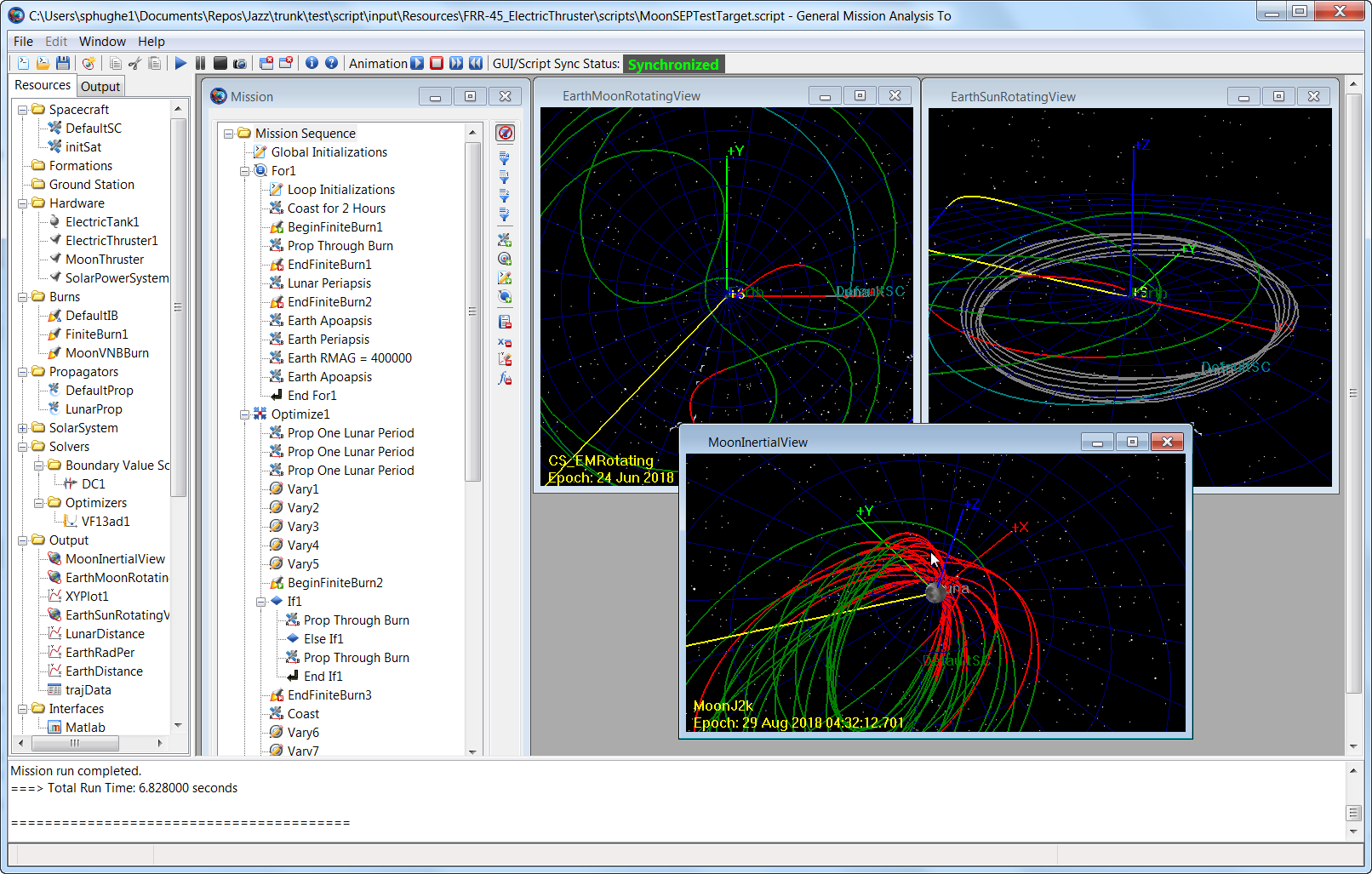
Below we illustrate some recent applications using GMAT. A solution is shown that uses a low thrust propulsion system and a cube-sat for a lunar mission.